




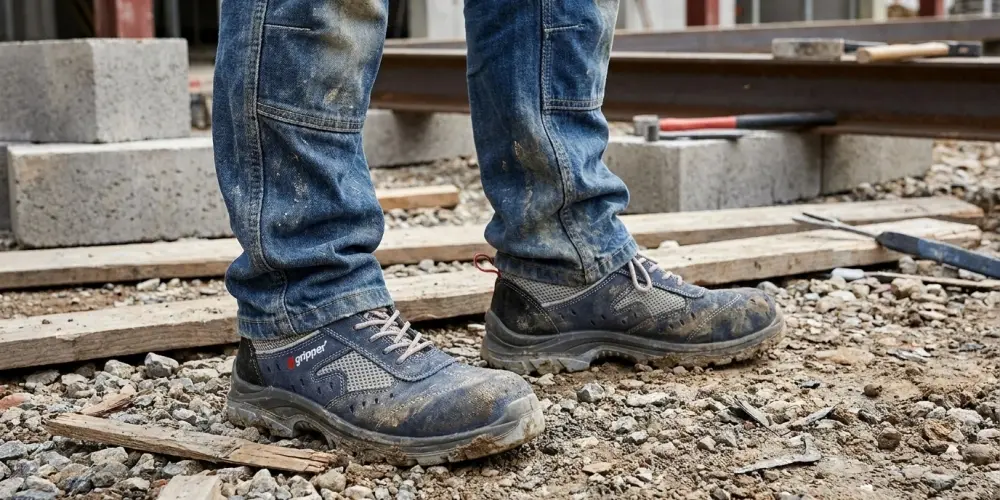
Steel toe safety shoes are safety footwear that help protect the toes against impact and compression hazards in the workplace. The right model should not be chosen on toe cap material alone; the EN ISO 20345 class, puncture risk, floor and ground conditions, exposure to water or moisture, and working hours should all be considered together.
EN ISO 20345 is the standard that defines the basic and additional performance requirements for safety footwear. Under the standard, the toe cap of safety footwear is assessed against requirements for 200 joule impact and 15 kN compression.
| Class | Basic Approach | Typical Use |
| SB | Basic safety requirements and toe cap | Work with limited additional risks |
| S1 | SB + closed heel + antistatic properties + energy absorption in the heel area | Dry indoor areas, warehouses, manufacturing |
| S1P / S1PL / S1PS | S1 + puncture-resistant sole protection | Dry work areas with a risk of sharp, penetrating objects |
| S2 | S1 + upper requirements for water penetration and water absorption | Environments with possible exposure to moisture or water |
| S3 / S3L / S3S | S2 + puncture protection + cleated outsole | Outdoor sites, construction sites and tougher ground conditions |
Want to look at the differences between S1P and S3 in more detail?
For a detailed comparison of puncture protection, water penetration, sole construction and applications, read our S1P vs S3 Safety Shoes guide.
Products with either a steel or a composite toe cap can meet the required performance under EN ISO 20345. So rather than asking “which material is safer?”, focus on the product's certified performance, weight, working environment and comfort.
Current safety footwear may carry P, PL and PS markings for puncture resistance. These indicate differences in the type of puncture-resistant insert used and in the test method.
This is why you may see codes such as S1P / S1PL / S1PS or S3 / S3L / S3S on newer products.
| Marking | Meaning |
| HRO | Outsole resistance to hot contact |
| CI | Cold insulation of the sole complex |
| HI | Heat insulation of the sole complex |
| WR | Water resistance of the whole shoe |
| AN | Ankle protection |
| SR | Additional slip resistance test |
The examples below are general guidance only. The workplace risk assessment and the manufacturer's technical documentation always take priority.
Browse related products
Steel Toe Safety Shoes · Composite Toe Safety Shoes · All Foot Protection Products
The material alone does not determine the level of protection. Both toe cap types can provide adequate protection if they meet the relevant EN ISO 20345 requirements.
No. The water penetration and water absorption requirements of class S3 are not the same as a fully waterproof shoe. Water resistance of the whole shoe is a separate technical property.
S1P includes puncture protection; S3 additionally includes water penetration / absorption requirements for the upper and a cleated outsole. Read our detailed S1P vs S3 comparison guide.
No. The four-digit notified body number appears next to the CE marking only where required by the applicable conformity assessment procedure. To confirm a product's conformity, check the manufacturer's information, the standard markings and the EU declaration of conformity (DoC) together.
Measure your foot in centimetres and check the brand's size chart; for the Mekap and Uvex charts and step-by-step measuring instructions, see our Safety Shoe Size Chart guide.


We use strictly necessary cookies to run this website. With your explicit consent we also use analytics and marketing cookies; in this context some data may be transferred to service providers outside Türkiye. You can change your choice at any time. Details: Cookie Policy